10 Minute Summer Reset for Busy Moms: 6 Steps to Less Chaos
This guide walks through a repeatable 10 minute summer reset for busy moms dealing with one specific problem: the low-grade household chaos that piles up faster once school's out than any other stretch of the year. By the end, you'll have a six-step sequence you can run in 10 minutes, one surface cleared, one intentional pause taken, one unrealistic expectation set down, and a clear standard for what counts as done.
Prerequisites: A timer. Ten minutes. No cleaning supplies required before you start.
What success looks like: Not a clean house. A functional one, meaning you can move through your main living space without navigating a problem, and you've taken one deliberate pause in the day. That's the benchmark.
One distinction worth making upfront: this summer reset routine for moms targets everyday friction, not clinical burnout. True burnout, characterized by emotional exhaustion, depersonalization, and a decrease in self-fulfillment according to the research, affects up to 5 million U.S. parents annually per the IIPB Consortium study (APA Monitor, October 2021). That requires more than a daily tidy. What this routine addresses is the layer underneath: the accumulated small stressors that make every hour heavier when left unmanaged. Psychologist Moïra Mikolajczak, whose parental burnout research is widely cited by the APA, notes that parents tend to focus on one or two big factors they can't change, while overlooking how many smaller stressors are actually tipping the scale (APA, July 2024). This routine moves the small ones.
Why summer specifically breaks the routine
Video of the Day
Summer removes the structure that keeps household load predictable without replacing it with anything. More people are home for longer stretches, mess accumulates on no fixed schedule, and the natural checkpoints that came with school pickups and drop-offs are gone. That's a logistics problem, not a discipline problem.
The stress load is real and documented. Ten years of APA tracking data show parents of children under 18 are consistently more likely to report high stress than non-parents. In 2023, one-third of parents rated their stress at 8 or higher on a 10-point scale, compared with just 20% of the rest of the population (APA, July 2024). Psychologist Inger Burnett-Zeigler at Northwestern University Feinberg School of Medicine frames the solution plainly: rather than holding out for a full hour of free time, find manageable pockets of relief that fit inside the day that already exists (APA, July 2024). That's exactly what this routine is built on.
Video of the Day
A 10 minute reset routine for busy summer days
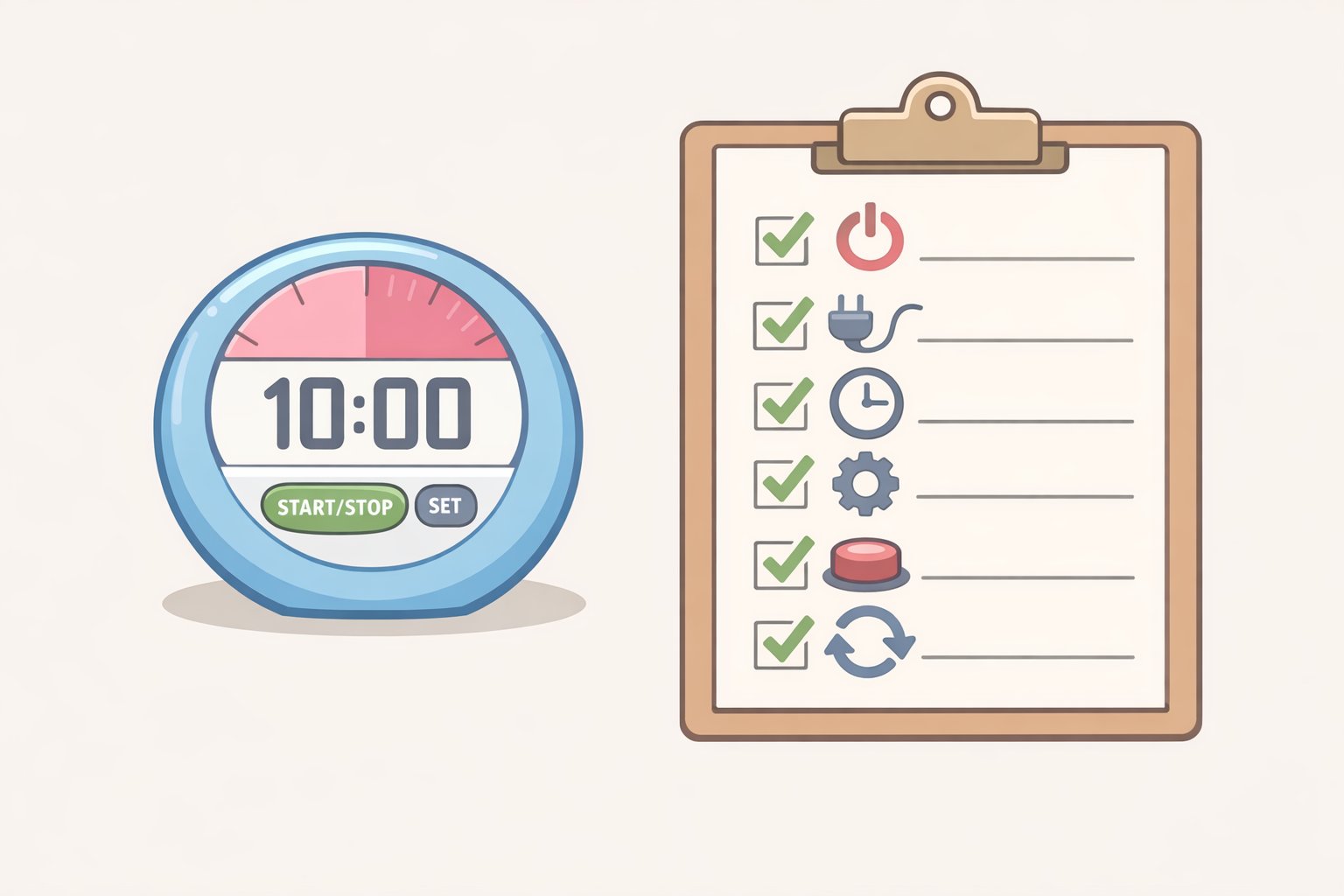
Run these in order. Each step builds on the one before it.
Step 1: Set the timer for 10 minutes before touching anything.
This is the most important step. The timer isn't motivation; it's a hard boundary that keeps the reset from becoming a cleaning session. When it goes off, you stop. Skip the timer and you don't have a reset. You have housework.
Step 2: Do a 60-second visual scan and identify one zone.
Walk the main living area without touching anything. Look for the one spot generating the most visual noise on every pass: the kitchen counter, the entryway, the couch arm where everything lands. That's your zone for today.
Pick the spot that bothers you most, not the one that needs it most. In practice, visible high-traffic surfaces generate constant low-level irritation every time you walk past them; clearing one delivers outsized relief for the time it takes.
Common mistake: Choosing something hidden, like a junk drawer or closet shelf. That's a separate project. This step is about visible impact, fast.
Step 3: Spend 4 minutes on that zone only.
Clear the surface. Return obvious things to their places. Anything without a clear home goes into one collection basket or moves out of sightline. You are not organizing or sorting. Done means you can see the counter, table, or floor area clearly. Not everything is put away, but none of it is in your face. That is the standard.
Step 4: Spend 2 minutes on one floor path people actually use.
The walkway between the kitchen and living room. The path from the back door. The area in front of the TV. Toys, shoes, bags: pile or bin, not sorted, just off the floor. In practice, a clear path reduces physical friction for everyone in the house, kids included.
Step 5: Take 2 minutes and stop completely. This step is not optional.
Step outside. Sit down. Stand at an open window. Don't use this time to plan the next task. APA guidance identifies brief, intentional pauses as resilience-supporting practices; even a few minutes of deliberate stillness makes a difference (APA, July 2024). The pause isn't a reward for finishing the steps above. It's part of what the reset is for.
If kids interrupt: Two minutes of sitting quietly with a child who isn't asking you to do anything still counts. Don't discard the pause because it wasn't perfect.
Step 6: Before the timer ends, set down one expectation.
The floors don't have to be swept today. Dinner doesn't have to be made from scratch. The toy bins don't need organizing this afternoon. Pick one concrete "should" you've been carrying and explicitly decide not to carry it for the rest of today.
Clinical psychologist Natalie Dattilo at Brigham and Women's Hospital and Harvard Medical School puts it directly: unrealistic expectations about how well things should be done and how happily you should be doing them add weight to the total load, and they're among the first things that can actually come off the plate (APA, July 2024). Her practical method: swap "should" language for accurate language. Instead of "I should keep this house cleaner," try "It would be better if the house were cleaner, and right now this is what's manageable." Dattilo describes that shift as dealing with your current reality rather than a version of reality you can't currently reach (APA, July 2024). Research supports the cost of skipping this step: parents who hold perfectionist standards experience measurably higher rates of burnout than those who don't, per Sorkkila & Aunola in the Journal of Child and Family Studies (2020), cited by the APA, July 2024.
When the timer stops, the reset is complete. Not when the house is clean. When the timer stops.
How to keep the reset from becoming your job alone
The quick summer cleaning routine above works well when you're the only one running it. The more likely scenario: you clear the counter, and within 20 minutes it's covered again.
This is the most common reason routines like this fail, and it has a practical fix. The goal isn't to protect your work; it's to redistribute the low-level maintenance so it doesn't fall entirely to one person.
A few things that work in actual households:
- One basket per shared room. Anything out of place goes in the basket, not sorted, not nagged about. Kids can drop things in. Partners can drop things in. Emptying the basket is a separate task, and it can belong to someone else.
- One entry rule for kids. Shoes in the bin before snack. Not organized, just in the bin. Kids old enough to open a cabinet are old enough to do this. State it once, enforce it consistently for a week, then stop reminding.
- One visible hotspot that belongs to your partner. The mail pile. The kitchen table. The area by the back door. One recurring zone, their call on when and how to clear it. Not negotiated daily; agreed once and left there.
The framing that makes this easier: you're not assigning chores, you're defining what "done" means for each person. A partner who owns the back-door zone doesn't need to be managed. A kid who has one job with one rule doesn't need to be reminded at every meal. The reset stays a 10-minute reset because other people are covering the parts you're not doing.
APA deputy chief for professional practice Lynn Bufka, PhD, frames the support question in the same terms: get creative with your network, whether that means a neighbor, a family member, or, if budget allows, a few hours of paid childcare or household help (APA, July 2024). The logic scales down just as well to a partner and a six-year-old.
How to run this in real summer conditions
The steps above work on an uncomplicated afternoon. Real summer days are rarely uncomplicated. Here's how the routine holds up across the slots where it actually fits:
After camp pickup, 4 p.m.: Kids are home, energy is high, bags and shoes are everywhere. Run the reset now, not after things settle, because things don't settle. Use the entryway or kitchen as your zone. The pause happens while kids get a snack. Step 6 is where you decide the backpack mess waits until tomorrow morning.
Before lunch, 11:30 a.m.: The morning is already behind you and the counter shows it. This slot works as a habit anchor because it happens every day before a predictable event. Zone: wherever breakfast left its evidence. Pause: before you start making lunch, not after.
After bedtime, 8:30 p.m.: Lower-urgency, but useful for anyone who sleeps better without visible disorder waiting for them. Zone: whatever bothered you most today. The pause doubles as the transition out of parent mode for the evening.
If the house is already relatively tidy: Run the same sequence at a shorter pace. The 4-minute zone becomes 2 minutes. Use the time left for a longer pause. The expectation-setting step stays either way.
If the timer goes off mid-task: Stop. Leave the half-cleared counter. Tomorrow it gets four more minutes.
To make any version stick, attach it to something that already happens rather than picking a new time each day. The most reliable slot in your schedule beats the theoretically optimal one. Pick it now, before tomorrow gets complicated.
What builds over a full summer
One reset is a better afternoon. Running this as a summer housekeeping habit through June, July, and into August is a different thing entirely.
What accumulates isn't a spotless house. It's the absence of the friction that builds when mess and unrealistic expectations go unaddressed for days running. A slightly calmer baseline, sustained by something that asks something realistic of you each day, is easier to operate from than one that doesn't.
This routine reduces friction; it doesn't replace support. Burnout is the result of too much stress and not enough resources to cope with it, as the APA's foundational framing makes clear (APA Monitor, October 2021). One ask of your network once a week isn't a sign the routine isn't working. It's the same logic at a slightly larger scale.
Pick tomorrow's anchor point today. Before the summer gets any busier, decide which daily slot this attaches to, and run it once. The second time is easier.